
Close Menu
  • Home
  • Politics
  • Business & Economy
  • Education
  • Environment
  • Immigration
  • Technology
  • Automotive
  • Things To Do
  • More
    • Web Stories
    • Global
    • Press Release
What's On

The people losing their homes in French-speaking Switzerland

2 May 2026

Swiss government waters down nursing reforms

2 May 2026

New EU employment rules could be costly for Switzerland

1 May 2026

How too many livestock keep Switzerland from feeding itself

1 May 2026

Taxing flights to fund train vouchers

1 May 2026
Facebook X (Twitter) Instagram
Web Stories
Switzerland Times
  • Home
  • Politics
  • Business & Economy
  • Education
  • Environment
  • Immigration
  • Technology
  • Automotive
  • Things To Do
  • More
    • Web Stories
    • Global
    • Press Release
Home » The reasons for Switzerland’s recent air pollution
Environment

The reasons for Switzerland’s recent air pollution

By switzerlandtimes.ch13 June 20252 Mins Read
The reasons for Switzerland’s recent air pollution
Share
Facebook Twitter LinkedIn Pinterest Email

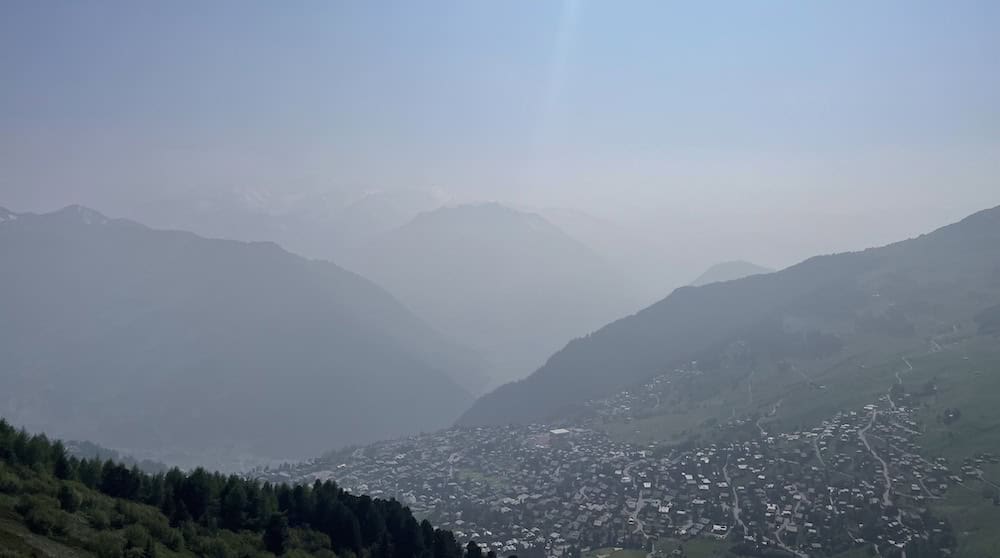
Much of Switzerland awoke last Sunday beneath a blanket of smog. The skies have since cleared somewhat, but the air remains far from pristine.

The sun’s dim appearance, filtered through a whitish haze, was not initially due to Saharan dust, as many might have assumed. Instead, the culprit was smoke from wildfires that have plagued Canada for several weeks. Fires in the provinces of Saskatchewan, Manitoba and Ontario have prompted evacuations and health alerts across parts of Canada and the United States.

When wildfires burn intensely over a wide area, smoke can rise high into the atmosphere. There, the jet stream—a fast-moving ribbon of air at altitude—can carry these particles across the Atlantic to Europe, , according to MeteoSwiss.

The suspended aerosols are significantly larger than air molecules, causing sunlight to scatter evenly across all wavelengths. This phenomenon, known as Mie scattering, gives the sky a milky appearance during the day and ochre tones at sunset.

More recently, dust from the Sahara has reached Switzerland, a migration that is ongoing. Canadian wildfire smoke has now dissipated—but in its place is sand from the Sahara.

Recent measurements show that pollution levels exceeded the daily average limit of 50 micrograms per cubic metre, a threshold that is not breached more than three times a year in Switzerland. The concentration of PM2.5 particles was 10 times the healthy limit set by the World Health Organisation.

More on this:
Swiss Meteo report (in French) – Take a 5 minute French test now

For more stories like this on Switzerland follow us on Facebook and Twitter.

Share. Facebook Twitter Pinterest LinkedIn Tumblr Email

Keep Reading

How too many livestock keep Switzerland from feeding itself

Swiss commission backs construction of new nuclear power plants

Tick bites on the rise in Switzerland

Swiss emissions down by 27%

Above average number of avalanche victims this winter in Switzerland

Swiss court upholds ban on chemical chlorothalonil

Swiss parliament backs road tolls for transit traffic

Winter returns to Switzerland after early spring warmth

Henniez forced to avoid some water sources after filtration scandal

Editors Picks

The people losing their homes in French-speaking Switzerland

2 May 2026

Swiss government waters down nursing reforms

2 May 2026

New EU employment rules could be costly for Switzerland

1 May 2026

How too many livestock keep Switzerland from feeding itself

1 May 2026
Latest Posts

The people losing their homes in French-speaking Switzerland

2 May 2026

Swiss government waters down nursing reforms

2 May 2026

New EU employment rules could be costly for Switzerland

1 May 2026
Facebook X (Twitter) Pinterest TikTok Instagram
© 2026 Switzerland Times. All Rights Reserved.
  • Privacy Policy
  • Terms
  • Advertise
  • Contact

Type above and press Enter to search. Press Esc to cancel.