
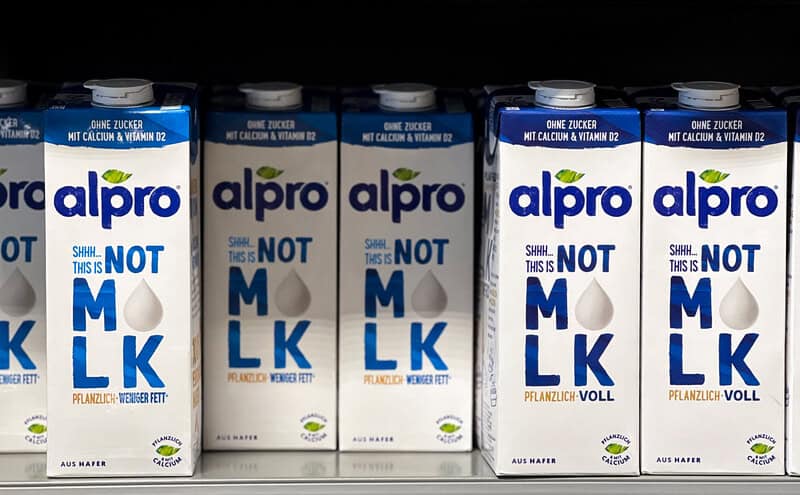
A product made from oats cannot be labelled “milk”, says Federal Supreme Court. In the court’s view, the term applies only to what comes from an animal’s udder.
The case centred on an oat drink sold by Danone under its Alpro brand in Swiss supermarkets such as Migros and Coop. Its packaging reads “Shhh… this is not milk”, with the “i” replaced by a droplet. The cantonal laboratory in Zurich, which tests food for contaminants, checks whether products are correctly labelled and investigates misleading claims or packaging, deemed this misleading.
Authorities argued that consumers might confuse the product with cow’s milk, not least because of its white-and-blue carton. A Zurich court agreed, finding that the overall presentation could mislead an average consumer.
A strict reading of the law
Swiss food law requires plant-based substitutes to be labelled in a way that avoids confusion with animal products. Terms such as “salami” or “meatloaf” are off limits for vegan goods. Because the rules leave room for interpretation, the Federal Food Safety and Veterinary Office has advised cantons that even negative claims—such as “this is not milk”—can be misleading.
The Supreme Court has now gone further. By a majority of four to one, it ruled that the word “milk” cannot appear on plant-based products at all, even in a negated form. One dissenting judge argued that no Swiss consumer would mistake such packaging for dairy. Terms like “soy milk” and “almond milk”, she noted, are widely used in everyday language. Her colleagues were unconvinced.
The ruling follows an earlier decision banning the label “planted chicken” for similar reasons.
Clarity over common usage
For some observers, the judgment feels out of step with consumer habits. Plant-based and dairy products are routinely sold side by side and used interchangeably—for coffee or muesli, for instance. Yet the court’s decision brings legal clarity. Unlike guidance from regulators or European practice, its rulings are binding across Switzerland.
Law, lobbying and evidence
Does the ruling reflect pressure from farmers? Not directly. Courts apply the law as written. But the framework they enforce—strict definitions of “milk”, “meat” and similar terms—has been shaped over time by political choices. Agricultural interests, particularly the dairy sector, have long argued for protecting traditional product names. The influence is therefore structural rather than case-specific.
What is largely absent from the judgment and the work of the cantonal laboratory in Zurich is empirical evidence. The court did not test whether consumers are actually confused by terms such as “oat milk” or “soy milk”.
That omission matters. A 2024 study in Switzerland found that consumers overwhelmingly distinguish between plant-based and dairy products, correctly categorising them as separate. If so, the case for restricting such terminology rests less on observed confusion than on legal definition.
More on this:
Court ruling (in French) – Take a 5 minute French test now
For more stories like this on Switzerland follow us on Facebook and Twitter.